A Skill-Swap Afternoon Built Around One Shared Task
Plan a skill-swap afternoon around one shared task, with clear teaching turns, useful questions, and a relaxed format that suits your group.
You set out a bowl of lemons, a cutting board, and a few clean jars; soon one guest is showing how to preserve citrus while another asks about knife grip. A skill-swap afternoon works best when everyone gathers around one shared task, rather than taking turns giving unrelated mini-lectures. The task gives the group something to do with its hands and a natural reason to teach, ask, and try.
The right format depends on who is coming and what they want from the afternoon. A group of close friends may enjoy an informal demonstration, while people who barely know one another often need clearer turns and a simpler activity. Choose the version that makes participation feel easy, not the one that crams in the most skills.
Choose the shared task
Start with an activity that can hold several small skills without requiring anyone to master a complicated result. Folding dumplings, mending a torn pocket, arranging a small bunch of flowers, or making a simple paper folder can each offer distinct things to teach while keeping everyone focused on the same work.
Look for a task with three qualities: materials are easy to gather, beginners can join partway through, and a useful result appears along the way. Avoid activities where one person must work alone for long stretches or where a mistake ruins the group’s materials. A shared task is like a kitchen table: it gives people a common surface, but everyone still needs room to reach.
Decide whether the goal is a finished object, a first try, or simply a chance to explain a technique. If the group includes mixed experience levels, make the goal modest. A repaired seam that holds, for instance, is more inviting than a promise that everyone will leave with a polished garment.
Match the format
For close friends: Use a loose circle of teaching turns. Each person can offer one small technique connected to the task, then pass the materials along. This suits people who already feel comfortable interrupting one another with questions.
For a mixed or unfamiliar group: Set a visible order for turns and give each person a short teaching window. That structure prevents confident voices from taking over and helps quieter guests know when their contribution is welcome.
For a small group with different abilities: Let people choose roles, such as demonstrating, preparing materials, trying the technique, or asking questions. This works well when not everyone wants to perform in front of the room, but everyone can still contribute.
For a group with limited time: Pick one task that can be paused cleanly and divide it into a few teachable parts. For example, a paper folder can involve choosing a crease, making a sharp fold, and decorating the finished piece. The group gets variety without changing activities or resetting the table.
Set clear turns
Before guests arrive, decide how teaching moves from one person to the next. A simple pattern is: the teacher names the skill, demonstrates it once, invites everyone to try, then pauses for questions before passing the lead. Say this aloud at the beginning so nobody has to guess when to speak or handle the materials.
Keep the teaching portions short enough that people can remember the first demonstration while trying it themselves. If a technique has several parts, show one part at a time. Place shared supplies in the middle, and make extra scraps or practice materials available when the task allows; people are more willing to experiment when the first attempt does not have to be perfect.
Make passing optional. A participant may teach, ask a question, demonstrate alongside someone else, or simply try the task. The point is to share knowledge, not to turn the gathering into a performance or test of expertise.
Prepare the room
Arrange seating so everyone can see the teacher’s hands. A table with chairs around it often works better than a row of seats, especially for a task involving small details. Put tools within reach and keep one clear patch of table for demonstrations.
Send a short note beforehand with the task, the expected duration, and anything guests should bring. If you are supplying materials, name what will be on hand so people can dress appropriately or flag an accessibility need. Follow product labels, manufacturer instructions, and local rules where they apply, particularly for food, tools, or materials that require special handling.
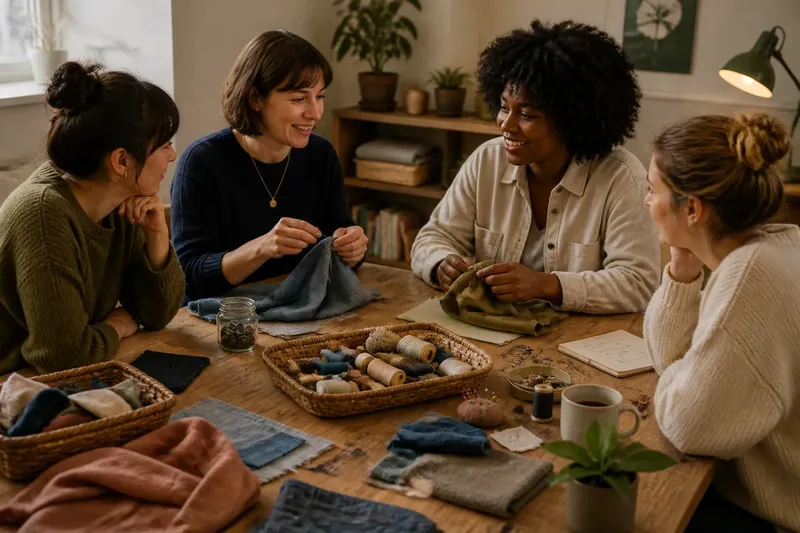
Say you invite four neighbors to mend clothing. One knows a basic running stitch, another has a button to replace, and the others are new to sewing. You bring needles, thread, spare fabric, and a few garments with small, non-urgent repairs; everyone practices on scraps first, then takes a turn showing one move. The observable result you can reasonably expect is a shared session where each person has tried a technique and knows what to practice next, even if some garments remain unfinished.
Keep questions useful
Questions are part of teaching, not a detour from it. Invite people to ask about a specific choice: where to place the needle, how tightly to pull the thread, or what to do if the fold slips. These questions help the teacher make hidden decisions visible.
If one person’s question becomes a long side lesson, acknowledge it and offer to return to it after the group has tried the current move. You can also keep a scrap of paper nearby for follow-up topics. That way the teacher can stay with the shared task without dismissing someone’s curiosity.
Which format fits your group?
How many skills should one afternoon include?
For a first gathering, keep the focus on one task and a few connected techniques. This makes it easier for people to learn from one another without spending the afternoon switching tools and instructions.
What if nobody feels like an expert?
Invite people to teach a small move they can explain, rather than claiming mastery of the whole activity. A participant who knows how to start a knot or choose a paper crease can offer something useful without presenting as an authority.
How can a shy guest take part?
Offer quiet roles such as preparing scraps, choosing materials, or trying a technique beside the teacher. Let guests know in advance that they may pass on teaching and still belong in the activity.
What if the task takes longer than expected?
Choose a natural stopping point before you begin, such as completing one sample or practicing one repair. If time runs short, guests can leave with the method they tried and a note about the next move, rather than rushing through every planned turn.
Close with a next move
End by asking each person to name one thing they learned and one place they might use it. Keep the response brief and voluntary. This gives the group a satisfying pause and helps teachers hear which explanations landed.
For a future skill-swap afternoon, keep the same simple frame but choose a different shared task suited to the people who can attend. The best invitation is specific: name the activity, say what guests can bring or expect, and make clear that beginners are welcome. A modest plan leaves enough room for the most valuable part—the moment someone tries a new move and another person gets to show how.