Why People Keep Sketchbooks Even When They Do Not Draw
A sketchbook can hold observations, fragments and unfinished ideas without asking them to become art. See how one imagined notebook makes room for noticing.
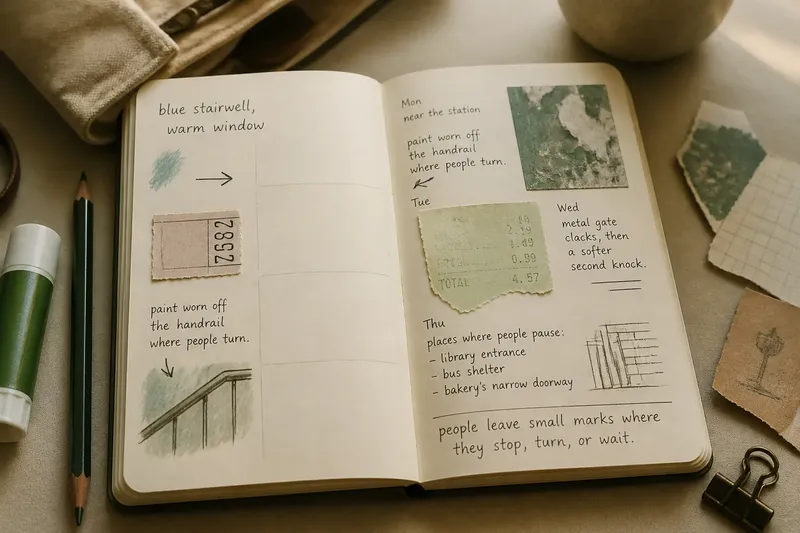
Mara opens her sketchbook on the bus, but she does not draw. She writes down the phrase “blue stairwell, warm window,” copies the shape of a torn ticket, and leaves three pages blank. Her sketchbook is useful precisely because none of those marks has to become a picture.
Why keep a sketchbook when you do not draw? In Mara’s imagined situation, the notebook gives scattered observations a place to wait together. It is neither polished artwork nor a formal record; it is a flexible surface for catching things before she knows what they might mean.
A notebook without a job title
Mara bought a pocket-sized sketchbook after noticing that ideas often arrived at inconvenient moments: while waiting for coffee, passing a construction site, or tidying a drawer. She initially thought she ought to fill it with drawings. When that expectation made her hesitate, she began using it for whatever she could record quickly.
On a walk, she might note that a bakery window fogs at the corners, paste in a paper label, or write a question about why a certain doorway feels inviting. These entries are not a diary with a daily account, and they are not organized notes intended to retrieve facts later. They are brief traces of attention.
A sketchbook can act like a kitchen counter: a place where ingredients sit together while you decide what to cook. The arrangement may be temporary, and not every ingredient will be used. Its value is that the pieces are visible at the same time.
One imagined notebook
Imagine Mara has been thinking about the small signs of wear in her neighborhood. She is not trying to make a series of illustrations or prepare a presentation. She simply wants to pay attention to what she keeps noticing, without deciding in advance what counts as a finished idea.
On Monday, she writes, “paint worn off the handrail where people turn.” Beside it, she draws a crooked arrow, not a polished sketch. On Tuesday, she glues in a corner torn from a grocery receipt because its pale green paper matches the paint she saw on a fence.
Later that week, she records a sound in words: “metal gate clacks, then a softer second knock.” On another page, she lists three places where people seem to pause: the library entrance, the bus shelter, and the bakery’s narrow doorway. She does not explain why she chose them. The page is a cluster, not a report.
One evening, Mara notices that the handrail entry and the doorway list seem to touch the same thought: people leave small marks where they stop, turn, or wait. She writes that sentence across the bottom of the page. It is not a conclusion about the neighborhood, just a connection she wants to keep within reach.
By the end of this imagined stretch of days, the sketchbook has not produced a finished drawing. It has produced a more specific question: what makes a place feel used without feeling neglected? Mara can carry that question into another walk, turn it into a drawing later, or let it remain a useful observation. The result is not a required project; it is a clearer sense of what has caught her attention.
Fragments have different uses
Each kind of mark supports a different kind of noticing. A sentence can preserve a detail that would be awkward to draw. A scrap of paper can hold color, texture, or lettering. A quick diagram can show where objects sit in relation to each other, even if it looks nothing like a finished illustration.
Unfinished ideas also benefit from staying unfinished for a while. A page can hold a question beside an image, or a phrase beside a rough shape, without forcing them into a single explanation. Later, the pairing might seem irrelevant. It might also suggest a direction Mara would not have reached by trying to make each entry stand alone.
This looseness separates a sketchbook from formal notes. Formal notes tend to serve a planned purpose: remembering instructions, recording a meeting, or organizing a topic. A sketchbook can hold material whose purpose is still unclear. If an observation needs to be dependable or easy to retrieve, Mara can copy it into a more suitable system rather than asking one notebook to do every job.
Keeping the pages usable
Mara makes the notebook easy to enter. She keeps a pencil and a glue stick near it, and she does not reserve pages for a perfect opening. A plain pocket sketchbook works; so does a spiral notebook, a stack of index cards held with a clip, or a digital page where images and short notes can sit together.
When she returns to a page, she adds a small date or location if that information will help her remember the circumstances. She avoids turning every entry into a polished caption. A few words such as “near the station” may be enough to bring the moment back.
She also lets blank pages stay blank. Filling every space can make the book feel like a task with a score to settle. Leaving room means a later fragment can sit beside an earlier one, and a missed day does not require an explanation.
If Mara wants to make an observation easier to find, she can add a simple mark in the margin or jot a short phrase on the inside cover. She does not need a complex index unless she genuinely wants one. The notebook should remain quick to use, not become a filing system she has to maintain.
Questions about sketchbooks?
Does a sketchbook have to contain drawings?
No. It can hold words, scraps, diagrams, color notes, or unfinished combinations. The name describes one possible use, not a rule for every page.
How is it different from a journal?
A journal often follows events, feelings, or reflections in sequence, while a sketchbook can gather isolated details without telling a continuous story. The boundary is personal, and a notebook can serve both purposes if that feels natural.
What if the pages look messy?
Messy pages can be useful when they preserve a thought before it disappears. If a page becomes hard to read, add a brief note nearby or copy the part you want to keep; there is no need to redo the whole spread.
Can a digital notebook serve the same purpose?
Yes, if it lets you capture fragments without much setup. A phone note, an image folder with short captions, or a tablet page can gather material just as a paper book can, though paper may make pasted scraps and quick marks easier to combine.
Letting a fragment lead
In Mara’s case, the useful outcome is not a finished artwork but a question that grew from repeated observations. Another person’s pages might lead nowhere beyond a phrase they enjoy, or might eventually become a drawing, a poem, or a practical idea. A sketchbook does not owe its owner a public result.
That is why people keep sketchbooks even when they do not draw: they offer a modest place for attention to leave a trace. If you want to try one, begin with something you noticed today—a sound, a label, a turn in the pavement—and record it in the form that comes easiest. The next page can wait until something else earns its place there.