The Interest Map: Turning a Passing Curiosity into a Good Question
An interest map turns a passing curiosity into a good question, helping you choose a small, focused way to explore without taking on a large project.
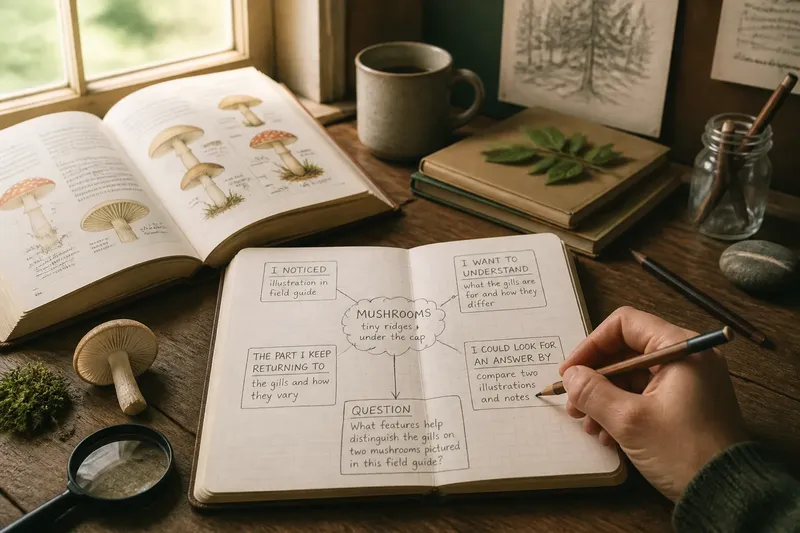
You pause beside a shelf of field guides because the drawings of mushrooms catch your eye. By the time you reach home, the interest has become a blur: fungi, forests, food, maybe something else. An interest map helps turn that flicker into one good question you can explore without signing up for a large project.
Start with the spark
Write down what first caught your attention, using plain words rather than a polished topic. “The tiny ridges under a mushroom cap” is more useful than “biology,” because it keeps the original curiosity visible.
Then note what you were doing when it appeared. Were you looking at an illustration, hearing someone tell a story, or trying to solve a small problem? The setting can reveal the kind of question that will hold your interest: visual, practical, historical, or social.
Keep this first note brief. The goal is not to prove that the subject matters or to decide what you will become good at. It is simply to preserve the detail that made you stop.
Follow the pull
Ask what you want to know next. A useful prompt is: “What am I curious about when I notice this?” You might want to identify a feature, understand why it varies, or learn how someone uses it.
Next, name the part that feels most alive. If mushrooms first drew you in through their shapes, your question may concern how form changes across species, rather than how to cook or cultivate them. This is a choice of direction, not a claim that the other directions are uninteresting.
Try completing these short prompts in order:
- I noticed…
- I want to understand…
- The part I keep returning to is…
- I could look for an answer by…
Do not force a neat answer to every line. If two different interests emerge, keep both for the moment. The map is a way to see the branches, not an order to prune them immediately.
Shape one question
A good exploratory question has a subject, a boundary, and something you can observe or learn. “How do mushrooms grow?” has a subject but leaves the scope enormous. “What features help distinguish the gills on two mushrooms pictured in this field guide?” gives you a bounded comparison and a place to begin.
Use words such as how, why, which, or what changes to make the question do some work. Then add a boundary: a particular setting, object, group, or kind of evidence. Boundaries keep a question from quietly turning into a whole research project.
Say you are intrigued by the way neighborhood birds seem to appear at different times. You jot down the original spark, “the sparrows are noisier near the bakery,” then ask what you want to know: whether food scraps affect where they gather. You narrow the scope to one street and a few observations made during ordinary walks; the question becomes, “Where do sparrows gather along this street when food scraps are visible?” That gives you a small, observable inquiry, without asking you to explain bird behavior everywhere.
Choose a small inquiry
Once the question is clear, choose an action that could bring you closer to an answer. You might compare two illustrations, inspect an object, ask a knowledgeable person one focused question, or keep a short note while you observe. Match the action to the question instead of choosing the most impressive-sounding method.
Decide what would count as a useful result before you begin. It might be a distinction you can explain, a pattern worth noticing, or a sharper question. An inquiry can be worthwhile even if it does not settle the original curiosity; it may show that the question needs a different boundary.
Keep the commitment modest in shape, not as a promise about how quickly you will finish. For example, choose a single source or a small set of observations, then pause to ask whether the question still interests you. If the subject opens into something larger, you can deliberately choose to continue rather than drift into a project by default.
When should you narrow it?
What makes a question too broad?
If answering it would require covering many settings, causes, or kinds of evidence, it is probably too broad for a small inquiry. Add one boundary, such as a particular object or situation, and see whether the question becomes easier to act on.
What if I have several curiosities?
Keep them as separate branches on the map rather than squeezing them into one question. Choose the branch you most want to follow now; leaving the others visible makes it easier to return later without losing them.
What if I cannot answer my question?
Check whether the question asks for something you can observe, compare, or learn from an available source. If not, revise one part of it: narrow the subject, change the kind of answer you seek, or turn it into a question about what evidence would help.
When should I stop exploring?
Pause when you have a satisfying answer, a more useful next question, or no wish to continue. Curiosity does not create an obligation; choosing to stop is part of keeping a small inquiry small.
Keep the map open
An interest map works better as a pencil sketch than a contract. A paper scrap, notebook margin, or simple note on your phone is enough: record the spark, the pull, the question, and the first inquiry you might try.
Think of it like a map drawn on a napkin: it marks a direction, not every road you may ever take. When a new detail changes your mind, revise the question instead of treating the change as failure. The aim is to make a passing curiosity usable while it is still yours.
The next time a small detail catches your attention, use the interest map to turn it into a question with a clear boundary and a possible first look. That is enough to begin exploring—and enough to decide, with better information, whether you want to go further.